There's no yard to stage from on a commercial site downtown. Access to the work came straight off the road, which meant blocking off parking spaces to get our people and materials in. On a quiet residential street that's a cone and a wave. Downtown, every space you take is a space a tenant, a visitor, or a delivery was counting on — so the plan starts with how you take the fewest, for the shortest time, and give them back the moment the work moves on.
That's the part of a concrete-and-paver replacement a property manager actually feels. The pour is the pour. The question is whether the building keeps working while it happens.
The order the work came back in
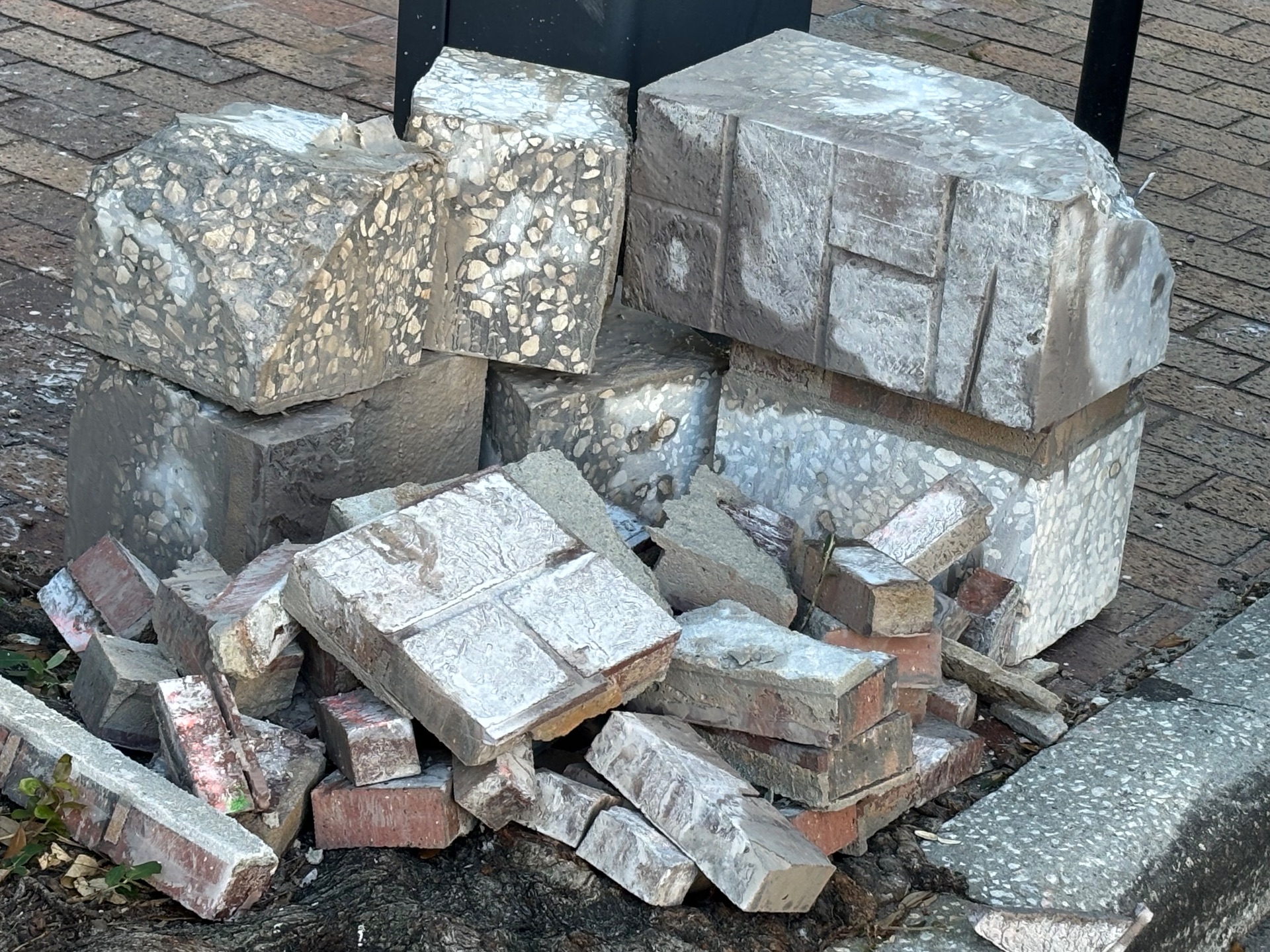
The scope here was straightforward to describe and unforgiving to execute: remove the failed concrete and pavers, and replace them to match the existing conditions. On an occupied downtown site, the sequence matters more than the square footage.
It went in order:
- Saw-cut and removal. The failed sections were saw-cut clean at the perimeter and taken out — no ragged edges, no breaking into concrete that was staying.
- Pour-back. Before new concrete went down, pipe work under the slab had to finish. That's not a delay to hide — it's the reason you investigate and sequence instead of pouring over a problem and tearing it out again later. Once the pipe repair cleared, the concrete went back in to match what was there.
- Pavers reset. Where the job called for pavers, they went back after the concrete, set to line up with the surrounding surface so the finished area reads as one piece, not a patch.
Each step waited for the one before it to be right. That's slower on paper and faster in real life, because nothing gets redone.
Leaving it like we were never there
The last day on this job wasn't a pour. It was cleanup. The plywood that protected the fresh work came up, the cones came in, and the site was swept and cleaned before we left.
That's not a courtesy line at the end of a scope — on an occupied property it's half the job. The people who use this site every day don't see the saw-cut or the pour-back. They see whether their walkway is level, whether their parking came back, and whether we left a mess. We left it clean.
Why the boring parts are the whole point
Nobody hires a contractor for a dramatic concrete pour. They hire one to make a failed stretch of concrete and pavers go away without turning their property into a construction zone for a month. The work that earns the next call is the quiet stuff: taking the fewest parking spaces, sequencing around the pipe repair so the new slab sits over a fixed problem, resetting the pavers flush, and sweeping up on the way out.
Get those right and the finished area doesn't look like a repair. It looks like it was always there.
If you manage a commercial property in Tampa Bay with concrete or pavers that have started to fail — trip hazards opening up, sections settling, pavers lifting — the first step is eyes on it. We'll walk your property with you, show you what's actually failing and what isn't, and scope the fix so you know what it takes before anyone blocks a single parking space.