The first thing that makes a concrete job at a lived-in community hard isn't the concrete. It's that people still live there.
At a condominium community in Tampa, we've been replacing failed driveway and sidewalk concrete across the property — and the whole time, residents have been pulling in and out, walking to their mail, getting on with their day. You can't fence off a community and come back in a month. So we don't. We work it area by area.
What "area by area" actually looks like
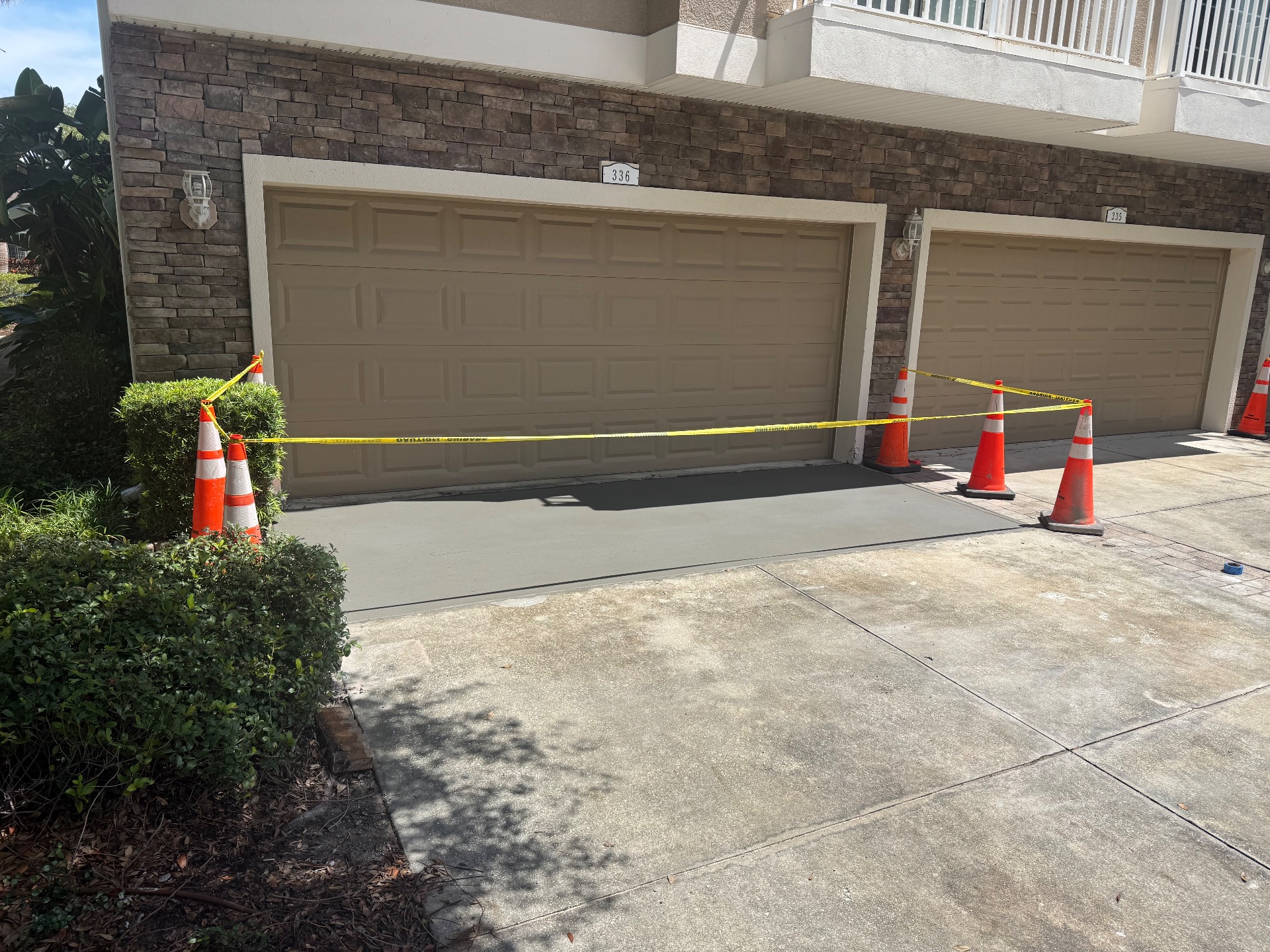
On one of the work days, the note from the field was short: our crew was onsite "completing 3 areas." That's the rhythm of a job like this. Instead of tearing out every bad slab at once and leaving the whole community torn up, we take it in sections — demo a defined area, replace it, let it set, move to the next.
It's slower on paper. But it means a resident is never cut off from their own driveway for longer than they have to be, and there's always a clear, safe way through the property while the work is going on. For a board or a community association manager, that's the difference between a project residents complain about and one they barely notice.
By mid-September the replaced concrete was, in the field's own words, "cleaned and curing." That's the quiet part of concrete work nobody photographs — the slab is poured, the area is swept clean, and now it just needs time. New concrete doesn't get used the day it's finished. It cures. Rushing a fresh pour back into service is how you get a surface that fails early, and we'd rather protect the slab than hit an arbitrary date.
Why the old concrete had to come out
Driveway and sidewalk concrete at a community fails for ordinary reasons — slabs settle, edges break, panels lift and crack until they're a trip hazard or a spot where water pools. Once a slab is past repair, grinding or patching only buys a little time. The honest fix is to take it out and replace it.
That's the scope here: remove the failed concrete, replace it, and leave the driveways and walks level and sound again. No dressing it up. When a sidewalk panel is heaved or a driveway apron is cracked through, the people who use it every day already know. Replacing it is what makes the property feel cared for instead of patched together.
The part residents remember
A resident doesn't read your scope sheet. What they remember is whether the crew was clean, whether they could still get to their car, and whether somebody told them what was happening before a section of their driveway disappeared.
That's where a concrete project at a community is won or lost. The pour has to be right — level, finished, cured before it carries weight. But the experience around the pour matters just as much: a tidy work area, clear access kept open, and no surprises. When the mail carrier reported root debris left near one unit, the crew folded a check of the areas they'd worked into the next pass. Small thing. It's also exactly the kind of thing that turns a one-time repair into the contractor a board calls back.
The work is still underway — concrete in, curing, more areas to go. But the pattern is the one we hold on every community job: take it in sections, keep people moving, leave each area better than we found it.
Walking your own property
If your community has concrete that's heaving, cracking, or pooling water — the driveway aprons, the sidewalks, the walks between buildings — the place to start is a walk-through. We'll come out, look at what's actually failing versus what still has life in it, and lay out a plan that takes the work in sections so your residents are never shut out of their own property.
Book a walk-through of your property and we'll tell you straight what needs replacing and what doesn't.